
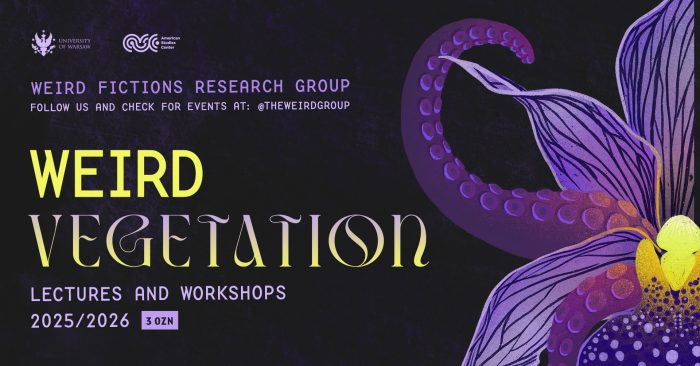
Weird Fictions Research Group invites you to join the third student lecture in the Weird Vegetation series in the spring semester 2025/26.
Thursday, April 23, 2026
4:45 pm
*3 OZN*
What?
This lecture examines how film uses hostile ecologies and vegetal forces to reproduce impairment in human bodyminds, throughout debility. Rather than treating disability as a character’s secondary or tertiary trait, the talk approaches it as something both central to the plot and generated through environments, toxins, and infrastructures. This attempt draws on disability studies and Jasbir Puar’s concept of debility as a socially and materially produced condition.[1]
Focusing on eco-horror, science fiction, and comic-book cinema, the lecture describes how films imagine plants, spores, radiation, and toxic landscapes as real, tangible powers that reconfigure embodiment, both explicitly and implicitly. In films like Annihilation,[2] ecological mutation dissolves the boundary between organism and environment; in 28 Days Later[3] or The Last of Us,[4] viral contamination directly threatens institutions and infrastructures; and in Batman & Robin,[5] botanical poisoning weaponizes plant life to weaken and control others. Across these just a few exemplary cases, the environment (vegetation) does not merely threaten life; it actively produces altered, dependent, or non-normative states of embodiment.
The lecture argues that weird vegetation narratives repeatedly stage what might be called ecological disablement: a process through which landscapes, toxins, and nonhuman agencies redistribute vulnerability across populations. By bringing disability studies into dialogue with eco-horror and film analysis, I propose that vegetal monstrosity often encodes cultural anxieties about environmental instability, bodily permeability, and the fragility of the autonomous, individual subject. At the same time, these films reveal how dependency, transformation, and collective survival are structured not only by bodies, but by the environments in which those bodies are forced to live.
[1] Jasbir K. Puar, The Right to Maim: Debility, Capacity, Disability (Durham, NC: Duke University Press, 2017).
[2] Annihilation, directed by Alex Garland (2018; Hollywood, CA: Paramount Pictures, 2018), film.
[3] 28 Days Later, directed by Danny Boyle (2002; London: Fox Searchlight Pictures, 2002), film.
[4] The Last of Us, created by Craig Mazin and Neil Druckmann (2023–; New York: HBO, 2023–), television series.
[5] Batman & Robin, directed by Joel Schumacher (1997; Burbank, CA: Warner Bros., 1997), film.
[2] Annihilation, directed by Alex Garland (2018; Hollywood, CA: Paramount Pictures, 2018), film.
[3] 28 Days Later, directed by Danny Boyle (2002; London: Fox Searchlight Pictures, 2002), film.
[4] The Last of Us, created by Craig Mazin and Neil Druckmann (2023–; New York: HBO, 2023–), television series.
[5] Batman & Robin, directed by Joel Schumacher (1997; Burbank, CA: Warner Bros., 1997), film.
SHORT BIO
Who?
Mikołaj Tkaczyk, an MA student in American Studies at the University of Warsaw and a graduate of Management at the same institution. His research focuses on the cultural and social aspects of disability, particularly identity, care, media, histories of institutionalization and activism, and embodiment in art. His current academic interests include crip lyricism and lived-experience narratives. Beyond academia, he has hosted a podcast featuring conversations with disabled scholars, activists, and influencers, and has participated in many educational initiatives.
Where?
Dobra 55, room: 2.118
*** Join us this summer semester for a whole new Weird Fictions series –> Weird Vegetation! We will be talking about deadly plants and strange forests, bio-terror and eco-systems, the role of nature in Eastern European weird fiction, sound and vision in plant audio horror, and more. Stay tuned! ***