
Dear Students,
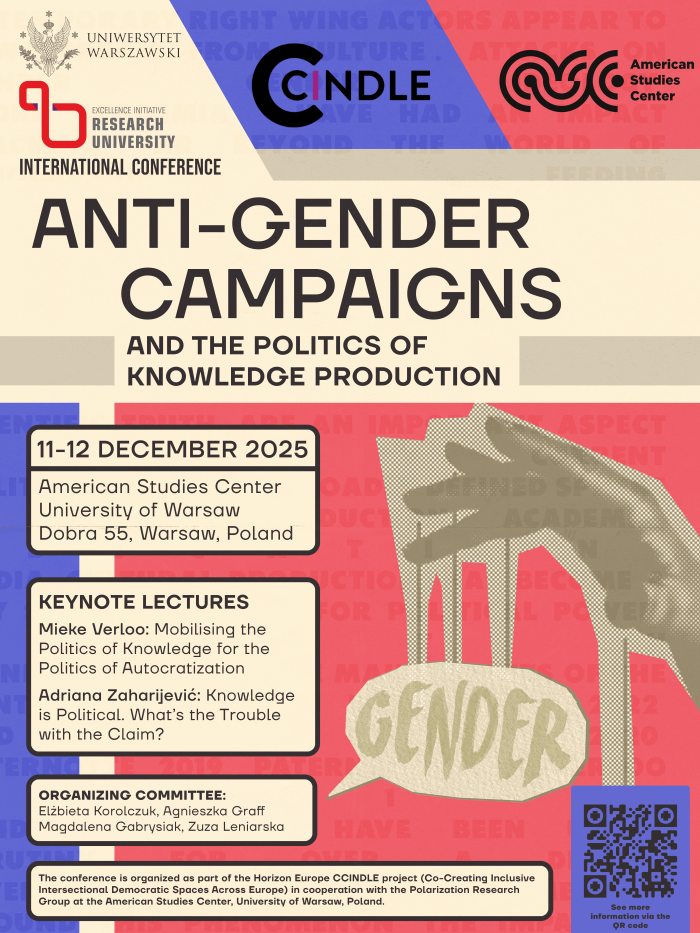
The American Studies Center at the University of Warsaw invites you to the international conference Anti-gender campaigns and the politics of knowledge production, to be held on 11–12 December 2025 in Warsaw, Poland.
This conference will explore the impact of anti-gender movements on academia, education, media, and cultural production, as well as their intersections with struggles around critical race theory, climate research, medicine, and the arts.
Registration
If you wish to attend the conference, please complete the registration form.
Volunteering
If you wish to volunteer at the conference, please complete the volunteer registration form.
For the participation in keynote lectures and panel sessions you will get 3 OZN each. We’re also looking for volunteers for the registration/information desk – for a 4-5 hour slot you can get 4 OZN.
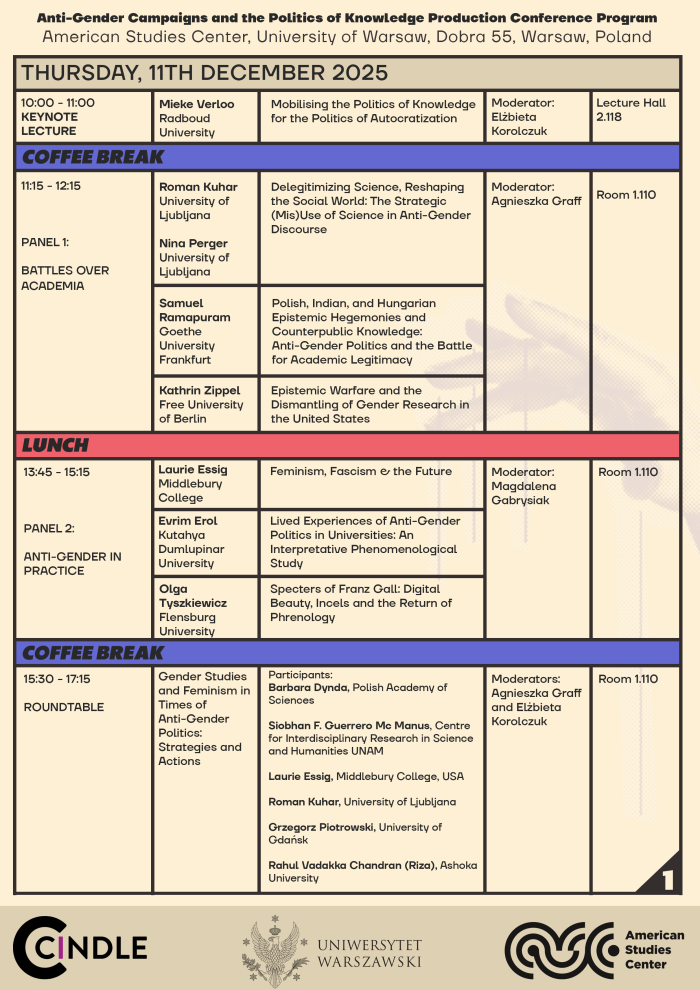
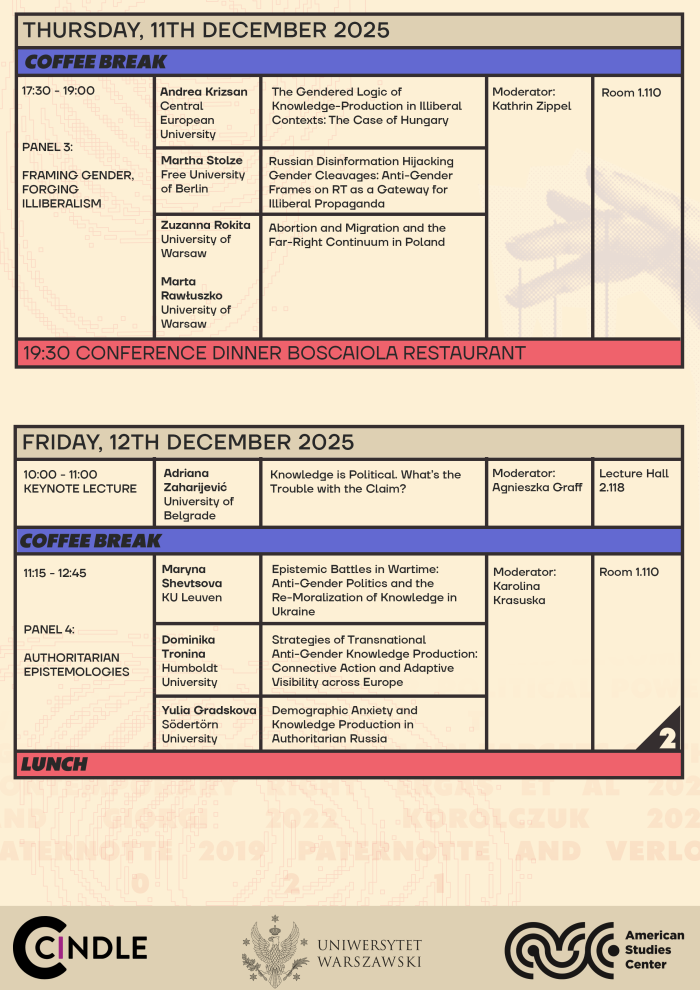
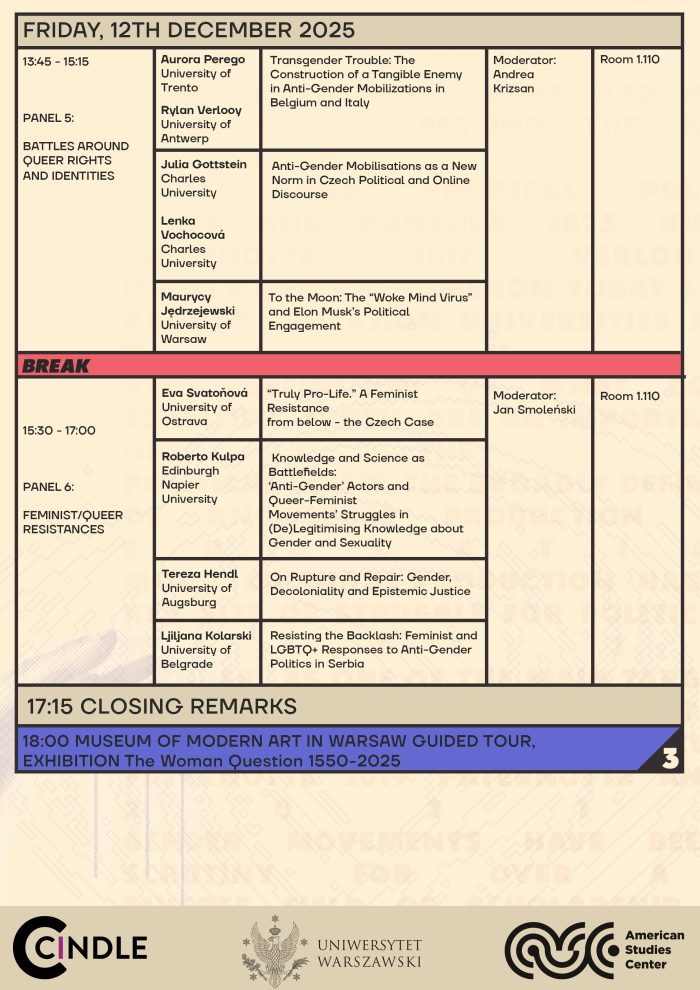
Find the full program below.
Contemporary right-wing actors appear to have learned the lesson that “politics is downstream from culture.” Attacks on “gender,” “gender ideology” – and more broadly, on “woke academia” – have had an impact reaching far beyond the world of scholarship, feeding social and political polarization (Ayoub and Stoeckl 2024; Dietze and Roth 2020; Korolczuk, Graff and Kantola 2025; Kuhar and Paternotte 2017; Verloo 2018). While anti-intellectualism is not a new phenomenon, today’s struggles around education, universities, as well as the very definition of what constitutes scientific truth, are an important aspect of the current political crisis. The broadly defined sphere of knowledge production (academia, education, media, cultural production) has become a key site of struggle for political power, with “gender” as one of the main targets of the contemporary right (Ergas et al 2022; Eslen-Ziya and Giorgi 2022; Korolczuk 2020; Paternotte 2019; Paternotte and Verloo 2021). While anti-gender movements have been under scrutiny for over a decade, resulting in an internally diverse field of scholarship emerging from this phenomenon, the impact of anti-genderism on knowledge production needs to be investigated further. This conference strives to do so.
Anti-gender movements constitute an important part of “the far right continuum” (Norocel 2023). As show in the Report on Anti-Gender Mobilizations’ Interventions in Knowledge Production published by researchers from the Horizon Europe CCINDLE project (Co-Creating Inclusive Intersectional Democratic Spaces Across Europe), the strategies of opposing what the right calls “gender” include both repressive and productive initiatives. In various countries anti-gender actors and the political parties collaborating with them have strived to delegitimize concepts such as “gender-based violence” or “systemic racism”; they have waged attacks on gender studies and/or critical race studies and they have closed down or cut funding for education programs dealing with those topics. Scholars working in these areas have been attacked either by activists disrupting their lectures or online, through cyberbullying and doxing. Simultaneously, anti-gender organizations and groups strive to promote their own set of truths regarding sex and gender, sexuality, reproduction, family, and identity. These actors publish books, articles and outcomes of academic studies; organize public debates and conferences and in some contexts also establish new institutions of higher learning with the goal of educating socially conservative elites. Scholars have argued that much of the knowledge produced by right-wing actors can be seen as counter-knowledge or troll-science (Eslen-Ziya and Giorgi 2022), and that is certainly true for anti-gender actors, whose aim is to undermine existing scholarship on gender identity, rather than to produce new data and theoretical concepts. As part of these troublesome practices, ironically, efforts to undermine academic freedom are often framed as defenses of freedom.
Given these developments, there is a need to examine this trend in more detail and analyze not only attacks on gender and critical knowledge but also feminist strategies of opposing this trend.
This conference is organized as part of the Horizon Europe CCINDLE project (Co-Creating Inclusive Intersectional Democratic Spaces Across Europe) in cooperation with the Polarization Research Group at the American Studies Center, University of Warsaw.
Organizing Committee:
Elżbieta Korolczuk, Agnieszka Graff, Magdalena Gabrysiak, Aleksandra Zuzanna Leniarska
References:
Ayoub, Phillip M., and Kristina Stoeckl. 2024. The Global Fight Against LGBTI Rights: How Transnational Conservative Networks Target Sexual and Gender Minorities. NYU Press. Dietze, Gabriele, and Julia Roth (Eds.). 2020. Right-Wing Populism and Gender, European Perspectives and Beyond. Transcript Verlag.
Ergas, Yasmine, Jazgul Kochkorova, Andrea Pető, and Natalia Trujillo. 2022. “Disputing ‘Gender’ in Academia: Illiberalism and the Politics of Knowledge.” Politics and Governance 10 (4): 121–31.
Eslen-Ziya, Hande, and Alberta Giorgi. 2022. Populism and Science in Europe. Springer Nature.
Korolczuk, Elżbieta. 2020. “Counteracting Challenges to Gender Equality in the Era of Anti- Gender Campaigns: Competing Gender Knowledges and Affective Solidarity.” Social Politics: International Studies in Gender, State & Society, 27(4): 694–717.
Korolczuk, Elżbieta, Agnieszka Graff, and Johanna Kantola. 2025. “Gender danger. Mapping a decade of research on anti-gender politics.” Journal of Gender Studies, 34(5), 621–640. Kuhar, Roman, and David Paternotte, (Eds.). 2017. Anti-Gender Campaigns in Europe: Mobilizing against Equality. Rowman & Littlefield Publishers.
Norocel, Ov Cristian. 2023. “Gendering the Far-Right Continuum in Europe”. The Routledge Handbook of Far-Right Extremism in Europe. Routledge.
Paternotte, David. 2019. “Gender Studies and the Dismantling of Critical Knowledge in Europe.” Academe 105 (4): 28–31.
Paternotte, David, and Mieke Verloo. 2021. “De-democratization and the politics of knowledge: Unpacking the cultural Marxism narrative.” Social Politics: International Studies in Gender, State & Society 28(3): 556-578.
Verloo, Mieke (Ed.). 2018. Varieties of opposition to gender equality in Europe (1st ed.). Routledge.
Book of Abstracts
Find the book of abstracts here.