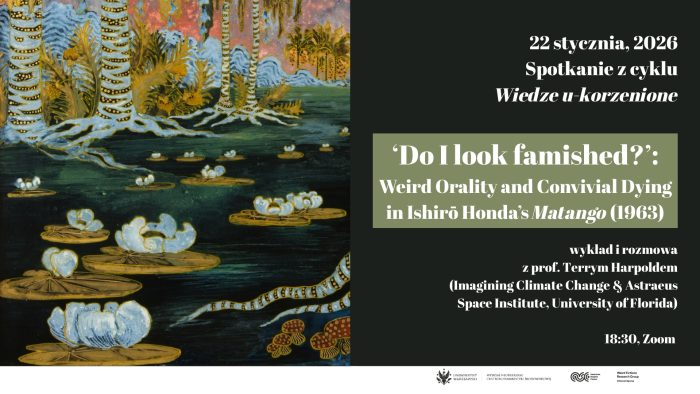
We’re cordially inviting you to the last open event in the “Wiedze u-korzenione” series in the fall semester 2025/26, co-organized by the Weird Fictions Research Group and Centrum Humanistyki Środowiskowej UW.
Thursday, January 22, 2026
6:30 pm
Zoom
*3 OZN*
What?
Matango (1963) is easily the weirdest film of director Ishirō Honda’s substantial œuvre; it is also Honda’s darke Hope Hodgson’s celebrated 1907 short story “The Voice in the Night” (screenplay by Takeshi Kimura, Shinichi quarrelsome castaways stranded on a sinister, fog-shrouded island with nothing to eat but mind– and body-mutating mushrooms, has been read by the few scholars who have taken the film seriously as an allegory of fracturing social norms and the spread of capitalist appetite and alienation in post-War Shōwa Japan.
My approach is keyed to the film’s distinctive framing of orality and the unsatisfiability of the oral drive (Freud’s film that turns the drive’s aim inside out. Rather than capturing or assimilating its object, weird orality, I propose continuity where before there was a gap. Unlike Hodgson’s gray, melancholy story of two lovers who reluctantly film the pop-psychedelic, brightly-colored fungi are alluring, consuming them is blissful. “Once you eat one you another castaway, “[even though] you’ll begin to look like a mushroom.” ( And looking like a mushroom isn’t a tragedy. Honda directed his crew to shoot Mami so that she appears more seductive the more she eats. Famously beautiful Mizuno has never been lovelier than in this scene.) Famously beautiful Mizuno has never been lovelier than in this sce the forest with the Mushroom People, survivors of earlier shipwrecks who surrendered to the delights of becom something happily disintegral and desubjectivized: a more mycelial way of belonging-with an inhuman world.
Who?
Terry Harpold (PhD, Comparative Literature and Literary Theory, University of Pennsylvania) is Associate Professor of English. His research and teaching are focused on the poetics and ethics of environmental transformation and climate change, with an emphasis on intersectional (human) and interspecies (more than human) approaches to environmental justice, equity, and resilience. He is also a scholar of science fiction literature and film from the mid-nineteenth century through to the contemporary era. A co-founder of UF’s Science Fiction Working Group, and founder and Director of UF’s Imagining Climate Change initiative, he is the Assistant Director for Humanities Research of UF’s Astraeus Space Institute. (More:
https://english.ufl.edu/terry-harpold/)
Anna Maria Grzybowska is a PhD researcher at the University of Warsaw. Her research is dedicated to exploring various (not-only-)human ways of experiencing the world, with a particular focus on how speculative fiction reimagines the human in relation to the complexities of the nonhuman. Her dissertation-in-progress investigates speculative visions of human-animal futures, examining how literature, film, and video games transform—or reinforce—the structures of the animal-industrial complex.
Where?
Online (ZOOM) – we will provide link soon!
*** Wiedze u-korzenione to cykl sześciu spotkań organizowanych przez Centrum Humanistyki Środowiskowej UW oraz Weird Fictions Research Group Ośrodka Studiów Amerykańskich UW w semestrze zimowym 2025/2026. Warsztaty, wykłady i spotkania z gośćmi/gościniami umożliwią nam wspólny namysł nad konceptem korzeni, grzybni, kłącza i roślinności w ujęciu zarówno humanistyki środowiskowej jak i w ujęciu kulturoznawczym. Czym jest ukorzenianie pamięci? Jak tłumaczyć język roślin? Czym są współczesne nauki o roślinach? Dlaczego eko-horror zapomina o środowisku? Na czym polega “wegetarianizm” popkulturowych wampirów? Czym są roślinne narracje sztuki? Zapraszamy wszystkich zainteresowanych odpowiedziami na te pytania! ***