
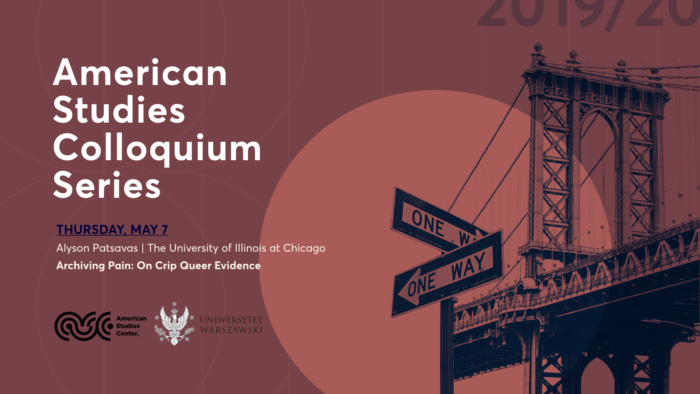
We are pleased to announce an online lecture by
Alyson Patsavas
(The University of Illinois at Chicago)
Archiving Pain: On Crip Queer Evidence
This lecture is going to be a part of the
American Studies Colloquium Series,
which are running online until regular
operations are resumed!
Thursday, May 7, 2020
at 4:00 p.m
It is still possible to get OZN points for participating
in this event! Check how to do this here.
Where?
Online on our Facebook group!
What?
This talk weaves personal experience, archival research, and a photo-essay together to ask how we might crip and queer evidence of pain. Philosophers, doctors, and pain studies scholars alike lament the absence of objective measurement tools to verify and prove pain’s existence. Arguments of pain’s purported resistance to language (Scarry) and uniquely subjective nature abound to frame personal accounts of pain as flawed, provisional, and suspect. Biomedicine has, in turn, offered an assortment of supplementary diagnostic tools meant to evidence pain—from pain scales to pain tracking apps. Despite the fantasy of certainty that such “biocertifications” (Samuels) offer, experiences of pain remain widely dismissed among women, older adults, and racial and ethnic minorities because of the absence of objective measurement tools. In this talk, I juxtapose material from a history of pain medicine collection with personal accounts of pain to track and interrogate the gaps between two differing archives of pain. In doing so, I outline dominant pain epistemologies and, drawing from critical theory’s interrogations and re-imaginings of archives, theorize what constitutes crip and queer evidence of pain.
Who?
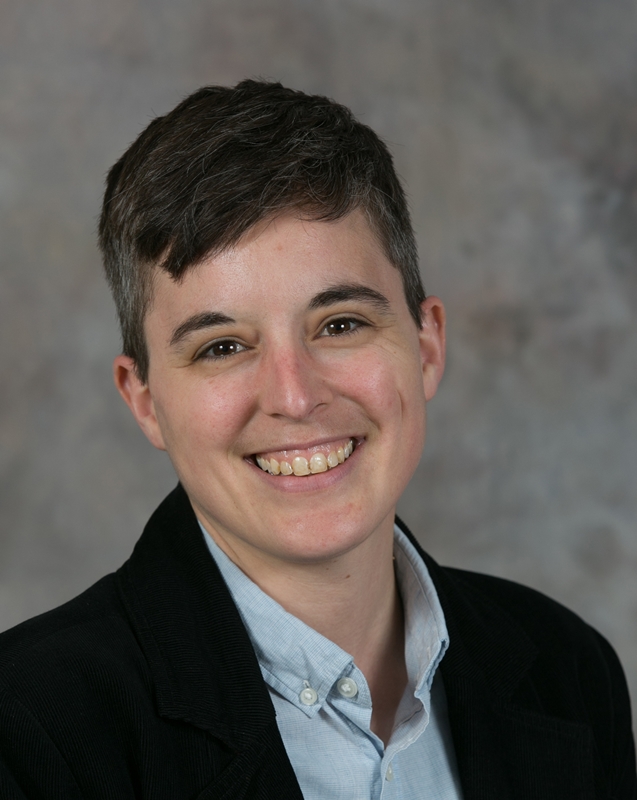
Her work appears in Different Bodies: Essays on Disability in Film and Television, The Feminist Wire, Somatechnics, Disability Studies Quarterly, The Czech Sociological Review, and the Journal of Literary and Cultural Disability Studies. Patsavas is also a writer and producer on the documentary film Code of the Freaks (2020) that examines crip culture’s response to Hollywood representations of disability. She is currently working on a manuscript that interrogates the discursive construction of pain and pain relief as a distinct cultural, economic, and political “problem” to theorize crip, queer interventions into how we come to know and understand pain.