
We are pleased to announce an online lecture by
Elizabeth Cullen Dunn
(Indiana University Bloomington)
Refugees and Racial Capitalism: What “Integration” in the US Labor Market Means?
This lecture is going to be the a part
of the 2020/2021 Fall Edition of the
American Studies Colloquium Series.
Thursday, January 21, 2021
at 4:45 p.m
You can get 2 OZN points for participating in this event.
Check how to collect OZN points online.
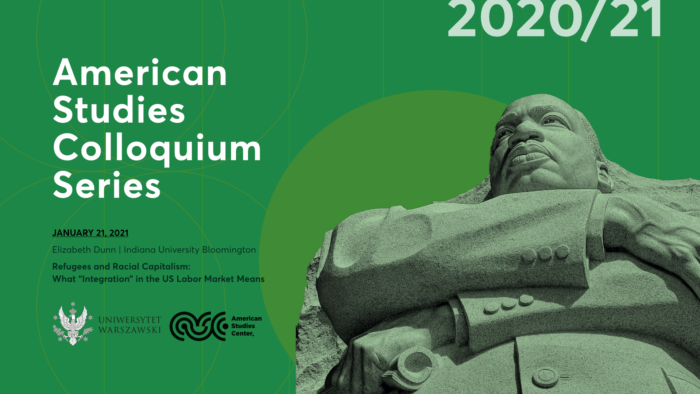
poster by Paulina Derecka (@paulinaderecka)
Where?
This lecture will be streamed online. To attend, click the button below or enter https://us02web.zoom.us/j/86141938754 into your browser, and join the meeting.
What?
Refugee resettlement has long been seen as a purely humanitarian act. When refugees are “integrated” into the labor market, it is seen as a tool to promote values such as self-sufficiency and dignity. But refugee labor is often needed by host countries, and refugees are often inserted into industries where they are tasked with jobs host country nationals refuse to do. Using the example of the American meatpacking industry, which relies heavily on refugees resettled by the US Department of State, I discuss why refugees were simultaneously deemed “essential” and “prohibited” during the COVID-19 epidemic. This paradox, in which refugees are both indispensable and stigmatized, is used to racialize and devalue their labor, creating ethnic enclaves in the labor market that simultaneously permit them to work and trap them in dangerous, underpaid jobs.

Who?
Elizabeth Cullen Dunn is Professor of Geography at Indiana University. Her current work focuses on refugees and labor.
She has worked on forced migration and humanitarian aid, which resulted in her book, No Path Home: Humanitarian Camps and the Grief of Displacement. Her first book, Privatizing Poland: Baby Food, Big Business and the Remaking of Labor, focused on blue collar workers in the food industry during the transition from state socialism.